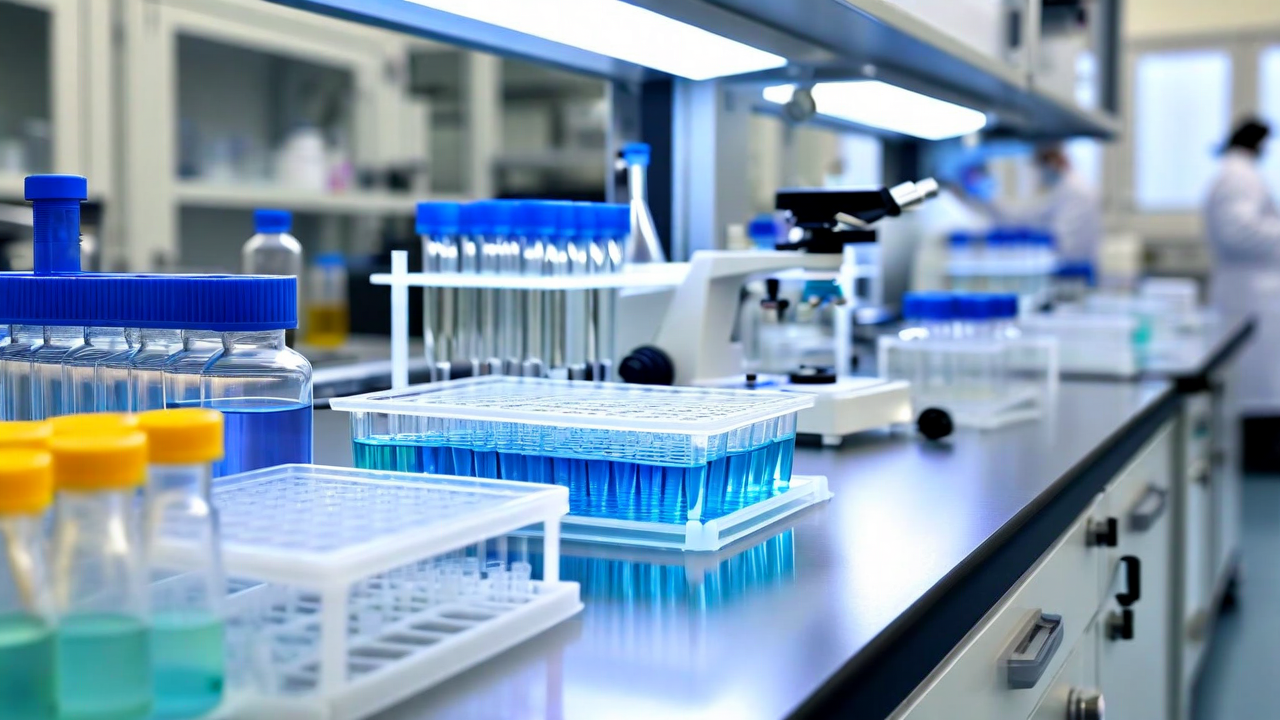
Most genetic testing companies describe the customer experience up to the point of sample submission, then skip to the results. What happens in between is a black box. We'd rather it wasn't.
This is a straightforward walkthrough of what actually happens from the moment your kit arrives at our CLIA-certified lab through to your results appearing in your secure portal - and what happens to your sample after that.
Step 1: Receipt and accessioning
Your kit arrives at the lab in a biohazard-safe shipping bag. The bar code on your collection tube is scanned into our laboratory information management system (LIMS), which creates a unique sample record linked to your account. Your name and personal details are not stored in the lab system - the sample is identified only by an anonymized lab ID. This pseudonymization means that even within the lab, your sample is separated from your identity during processing.
You receive a portal notification when your sample has been accessioned. This typically happens within 24 hours of lab receipt. From this point, our standard turnaround commitment is 14 days to final results.
Step 2: DNA extraction
The collection swab goes through an automated DNA extraction protocol designed to isolate genomic DNA from the buccal cells collected during your swab. The buffer solution in the collection tube has been stabilizing the cells since you collected your sample; extraction begins by chemically lysing those cells to release the DNA.
After extraction, a quality check is run. We use fluorometric quantification to measure the amount of DNA obtained, and spectrophotometric ratios to assess purity. If a sample doesn't meet our minimum thresholds for quantity or quality, we contact you to arrange a free recollection. We don't proceed with a borderline sample and hope for the best.
Step 3: Genotyping
Samples that pass quality control are prepared for genotyping on a high-density array. Your DNA is chemically amplified and then hybridized to the array - a process where your DNA sequences bind to complementary probes at specific positions across the array surface. The binding pattern tells us which variant you carry at each of the 700,000+ positions we test.
The array is scanned to produce raw intensity data for each probe position. A calling algorithm converts those intensity values into genotype calls - which of the two possible variants you carry at each position. Calls that fall below our confidence threshold are flagged as missing data rather than assigned a low-confidence call, which is the more conservative and accurate approach.
Quality metrics including call rate (the percentage of positions successfully genotyped) and sample heterozygosity are checked at this stage. Samples falling outside expected ranges are flagged for review before proceeding.
Step 4: Bioinformatics processing and report generation
The verified genotype data feeds into our analysis pipeline. Different report modules run in parallel: ancestry composition analysis compares your variant pattern against our reference population database; health predisposition scoring aggregates weighted variant effects for each condition; pharmacogenomics classification assigns metabolizer phenotypes based on haplotype analysis; carrier status calls are made against a curated variant database.
Each output passes through validation checks before it's written to your report. Edge cases - ambiguous haplotype combinations in pharmacogenomics, for example - are handled by defined rules and flagged for human review when outside standard parameters.
Step 5: Results delivery
When your report passes all pipeline validations, a notification is sent to your registered email address and your portal is updated. High-disclosure result categories that you've opted to gate require a separate click-through before the results are displayed. This is intentional: we don't want significant findings surfaced to you without a moment to prepare.
What happens to your physical sample
Your saliva swab and collection tube are destroyed within 60 days of analysis completion. There is no sample archive. We don't retain the physical sample for any subsequent testing unless you specifically request storage, which is an opt-in feature available in your account settings. If you don't activate storage, your sample is gone after 60 days.
Your digital genotype file - the data generated from the sample - is retained in encrypted storage for as long as you maintain an account with GeneLens, so that we can update your reports as our methodology improves without requiring another test. If you close your account or request data deletion, the genotype file and all derived reports are permanently deleted from our systems within 30 days. We do not retain archived copies after a deletion request.
That's the whole process. No hand-waving, no vague references to "our state-of-the-art laboratory." If you have questions about any step, our team is reachable at [email protected] and we'll answer them directly.